Turn the page

If you love all things GRAINS this Pageturner is for you

×

Cookbooks from Apple to zucchini

The virtues of whole grains
by Howard E. LeWine, MD
Whole grains are better than refined grains and how to add more to your diet.
Whole-grain foods are good choices for a nutritious diet. Whole grains provide fiber, vitamins, minerals and other nutrients.
Whole-grain foods help control of cholesterol levels, weight and blood pressure. These foods also help lower the risk of diabetes, heart disease and other conditions.
The Dietary Guidelines for Americans recommends that at least half of all the grains you eat are whole grains. Most people in the United States don't eat enough whole grains.
Whole grains reduce your risk of heart disease, stroke, and type 2 diabetes. But they do even more: people that eat a diet rich in whole-grain foods live longer compared to those who eat foods made from refined grains.
All grains grow as kernels. Each kernel has three layers:
~ The inner germ contains many of the vitamins, minerals, and healthy oils.
~ The middle layer is called the endosperm. It is primarily starch and makes up most of the kernel. It provides the energy the kernel needs to start growing.
~ The outer coating, known as bran, contains most of the grain's fiber.
In the 1880s, millers became very adept at separating the layers, especially for wheat. The starchy middle layer was ideal for baking. These new refined grains became very popular. White bread crowded grocery store shelves for the next 100 years. Goodbye to the germ and bran, along with their nutritional value.
When you eat a whole grain, you're getting more than just the fiber from the outer layer. You also get all the vitamins, minerals, good fats, protein, antioxidants, and other healthful parts of the grain's inner layers.
It's easy enough to decide between brown rice and white rice. But selecting whole-grain breads and cereals often requires a close reading of the food label.
Don't be fooled by terms such as "wheat flour," "unbleached wheat flour," and "enriched wheat flour." They can refer to refined white flour.
The same goes for "stone-ground," "multigrain," "fortified," "stoned wheat," "cracked wheat," and "organic." None of these terms guarantees that the product is whole grain.
To be sure that you are really getting whole grains, look for the word "whole" or "whole-grain" before the grain's name as the first ingredient.
And it's not enough that "made with whole grain" appears somewhere on the list of ingredients. That grain may have been refined. Again, the key is the word "whole" in the first ingredient listed — for example, "stone-ground whole wheat."
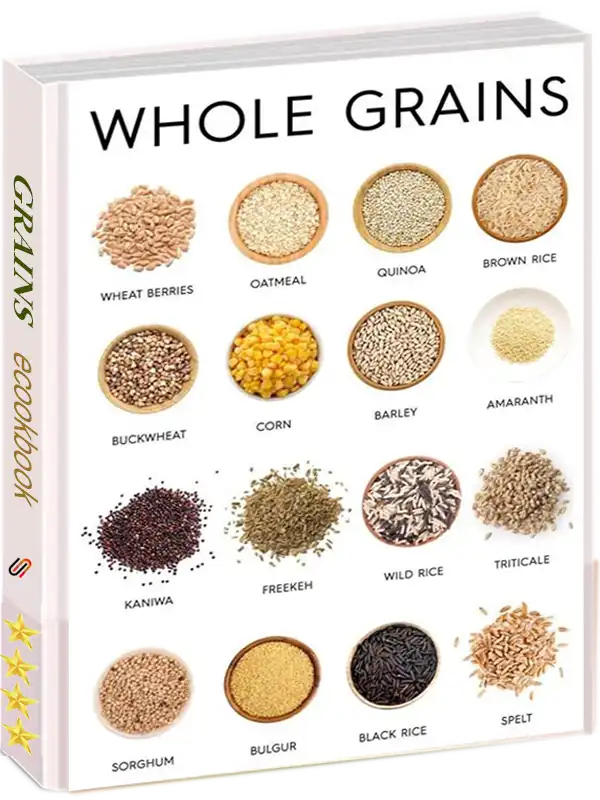
Wheat berries
Wheat berries are very healthy because they are whole, unprocessed wheat kernels that contain the entire grain.
Key Health Benefits
High in Fiber: A single serving provides a large portion of your daily fiber needs, which helps your digestion and keeps your gut healthy.
Steady Blood Sugar: They have a low glycemic index, meaning they digest slowly and prevent sharp blood sugar spikes. Plant-Based Protein: They offer more protein than many other grains, supporting muscle repair and overall body function. Vitamins and Minerals: They are packed with iron, magnesium, zinc, manganese, and B vitamins. Heart Health: Eating whole grains is linked to a lower risk of heart disease and lower cholesterol levels.
More info available at: https://draxe.com/nutrition/wheat-berries/
Oatmeal
Oatmeal
Oatmeal vs. Oats
What's the Difference?
Oatmeal and oats are both derived from the same source, which is the oat grain. However, they differ in terms of their form and preparation. Oats refer to the whole grain, which is typically processed by removing the outer husk, leaving behind the oat groat. These groats can be further processed into different forms, including rolled oats, steel-cut oats, or instant oats. On the other hand, oatmeal specifically refers to the groats that have been finely ground or chopped into smaller pieces, resulting in a more easily cooked and digestible product. While oats can be used in various recipes, oatmeal is primarily consumed as a hot breakfast cereal.
Oats are a good source of many vitamins, minerals, and unique plant compounds. This grain also offers a number of potential health benefits, including reduced cholesterol and improved insulin sensitivity.
They are a very good source of fiber, especially beta glucan, and are high in vitamins, minerals, and antioxidants.
Whole oats are the only food source of avenanthramides, a unique group of antioxidants believed to protect against heart disease.
In addition, oats are very filling and may reduce appetite and help you eat fewer calories.
Due to their many benefits, such as lowering blood sugar and cholesterol levels, oats have gained considerable attention as a health food.
Quinoa
Quinoa
Quinoa ecookbook
Quinoa is the only food of vegetable origin that provides all the essential amino acids, trace elements and vitamins, equating its protein quality to that of milk.
It is gluten-free. Its grains are highly nutritious, surpassing cereals, such as wheat, corn, rice and oats, in biological value and nutritional quality. After harvest, the seeds are processed to remove the bitter-tasting outer seed coat.
Quinoa originated in the Andean region of northwestern South America, and was domesticated 3,000 to 4,000 years ago for human consumption in the Lake Titicaca basin of Peru and Bolivia, though archaeological evidence shows livestock uses 5,200 to 7,000 years ago.
One cup of cooked quinoa has about 40 fewer calories than the same amount of white rice, but the real benefit is in the carbohydrates. White rice has almost 15 times more grams of carbohydrates, and quinoa provides 5 more grams of fiber and double the protein. There are roughly 120 known varieties of quinoa, according to the Whole Grains Council. The most commercialized types are white, red and black quinoa and many more colors in between.
Rinse quinoa before cooking:
This is because quinoa has a bitter-tasting natural coating called saponin. Essentially, it is a self-defense mechanism that protects the seeds from pests. While virtually all quinoa that is sold in the markets today has already had the saponin removed with various techniques some people might taste the bitterness that may have remained after processing. That is why it is recommended to placethe plant to protect itself from fungi, birds, insects, and other foraging animals in its natural habitat.
quinoa in a fine mesh strainer and give it a good rinse under cold water until the water runs clear.
There are over 3,000 varieties of quinoa.
However, the most widely grown types are red, black and white. There is also a tricolor variety, which is a mixture of all three.
Quinoa can also be rolled into flakes or ground into flour, which can then be used for cooking and baking.
White quinoa is the most commonly consumed variety, and is what you’ll usually find at the store. Interestingly, the different types also have varying nutrient contents.
A study examining red, black and white quinoa found that while black quinoa has the lowest fat content, it has the highest omega-3 fatty acid and carotenoid contents (3Trusted Source).
Red and black quinoa also have nearly twice the vitamin E content of white quinoa.
The same study analyzed the antioxidant content of each type and found that the darker the color, the higher the antioxidant capacity.
Common varieties and types of quinoa:
White quinoa
Red quinoa
Black quinoa
Tri-color or rainbow quinoa (a mixture of all three colors)
Quinoa flour
Quinoa flakes
Quinoa crisps
Brown rice
Buckwheat
Corn
Barley
Amaranth
Kaniwa
Freekeh
Wild Rice
Triticale
Triticale is an interesting member of the cereal grain family.
The cross is done by using male wheat and female rye. Both are gluten-containing grains, though decidedly lower in this plant protein than radiation-mutated modern wheat.
Why Cross Wheat and Rye?
The reasons for creating a wheat/rye hybrid are similar to why humans hybridize other plants. Hybrids tend to increase hardiness and/or improve yield.
Wheat has a number of drawbacks, such as poor disease resistance and preference for very particular soils. Rye does well in more varied soils and conditions and has excellent disease resistance. Yet, rye’s yields are far lower than wheat, so plant breeders considered the two grains to be a perfect match.
As we will see below, grains from certain plant families – especially rye, wheat, and barley – are closely related. Thus, they have swapped genetic info for generations to create many of the traditional grains we appreciate today!
What is Triticale Used For?
Triticale isn’t generally grown or used as a commercial crop for food production. Rather, it serves as a fodder crop for numerous animal species around the world. Feeding experiments in animals indicate that it is more digestible, which has increased its popularity. Only recently did people start using it and considering it as a possible staple crop. Since many cultures around the world depend on cereal grains as a main source of calories, it may one day prove to be an important crop to feed large population groups. You may have come across it in health food stores or on limited food labels. It is typically sold as rolled triticale for porridge making. Alternatively, the berries come in bags like any other grain for sprouting or grinding into flour to make bread, rolls, and other baked goods.

Heritage Grains vs Triticale
Many healthy heritage grains enjoyed today have hybrid roots. spelt, Kamut, emmer, white Sonora, and red fife are some of the best known.
Did the cultivation of triticale come about in a similar way over the millennia? Here is a good summary from the Weston Price Foundation about the origins of heritage wheat.
Among the early grasses that produced nourishing food for people is the species of Triticum. Within this species, the einkorn, emmer and spelt groups all had a common ancestor about 10,000 years ago. Wild and cultivated einkorn are classified as diploid by plant geneticists; that is, their DNA contains two sets of chromosomes…A variant of wild einkorn probably mixed with another diploid wild grass, T. speltoides to produce a tetraploid cereal, T. dicoccoides, called wild emmer, with 4 sets of chromosomes.
With more inherited characteristics, cultivated emmer wheat eventually pushed out einkorn in popularity as it could thrive in more environments and under wider, warmer, climate variations….Cereal geneticists have two theories for the sites of the emergence of spelt, a hexaploid wheat variant with 6 sets of chromosomes, but they agree that either wild or cultivated emmer must have moved into a geographical area where T. tauschii (goatgrass) was an indigenous species (southern Russia, western Iran and northern Iraq).
Just as emmer wheat benefitted (sic) by the addition of genetic material in its adaptive advantage over einkorn, spelt (T. spelta) exhibited even more adaptability from the contribution of the characteristics of its wild grass parent. The spelt group of wheats are all hexaploid, although it is interesting to note that there are no known wild hexaploid forms of Triticum.
Sorghum
Bulgur
Black rice
Spelt
conversion of liquids
Type a value in one of the inputs below to convert into other units.
Liters - l
Déciliters - dl
Centiliters - cl
Milliliters - ml
USA
UK, Canada
Gallons - gal
Pints - pt
Cups - c
Ounces liquids - fl oz
Tablespoons - tbsp
Teaspoons - tsp
Weights
Type a value in one of the inputs below to convert into other units..

Kilogramms :  kg
Gramms :  g
Pounds :  lb
Ounces :  oz

Temperatures

Type a value in one of the inputs below to convert into other units.

Degrees Celsius :  °C
degrees Fahrenheit :  °F

Measures of non liquid ingredients


Non-liquid ingredients in volume converted
into weight using the table below.
For products not included, use a metric scale
Weight of specific 'ingredients in grams

Ingredient

1 cup

3/4 cup

2/3 cup

1/2 cup

1/3 cup

1/4 cup

2 tablespoons

All-purpose wheat flour 120 g 90 g 80 g 60 g 40 g 30 g 15 g
All-purpose sifted wheat flour 110 g 80 g 70 g 55 g 35 g 27 g 13 g
White sugar 200 g 150 g 130 g 100 g 65 g 50 g 25 g
Powdered sugar/Icing sugar 100 g 75 g 70 g 50 g 35 g 25 g 13 g
Brown sugar normally packed 180 g 135 g 120 g 90 g 60 g 45 g 23 g
Corn flour 160 g 120 g 100 g 80 g 50 g 40 g 20 g
Cornstarch 120 g 90 g 80 g 60 g 40 g 30 g 15 g
Rice (not-cooked) 190 g 140 g 125 g 95 g 65 g 48 g 24 g
Macaroni (uncooked) 140 g 100 g 90 g 70 g 45 g 35 g 17 g
Couscous (uncooked) 180 g 135 g 120 g 90 g 60 g 45 g 22 g
Quick oatmeal (uncooked) 90 g 65 g 60 g 45 g 30 g 22 g 11 g
Table salt 300 g 230 g 200 g 150 g 100 g 75 g 40 g
Butter / Margarine 240 g 180 g 160 g 120 g 80 g 60 g 30 g
Shortening 190 g 140 g 125 g 95 g 65 g 48 g 24 g
Fruits and légumes chopped 150 g 110 g 100 g 75 g 50 g 40 g 20 g
chopped walnuts 150 g 110 g 100 g 75 g 50 g 40 g 20 g
Nuts /ground almonds 120 g 90 g 80 g 60 g 40 g 30 g 15 g
Fresh bread crumbs (not packed) 60 g 45 g 40 g 30 g 20 g 15 g 8 g
Dry bread crumbs 150 g 110 g 100 g 75 g 50 g 40 g 20 g
Parmesan grated 90 g 65 g 60 g 45 g 30 g 22 g 11 g
Chocolate chips 150 g 110 g 100 g 75 g 50 g 38 g  19 g
  • Mediterranean Complete E-cookbook
  • Italy Complete E-cookbook
  • France Complete E-cookbook
  • Spain Complete E-cookbook
  • Canada Complete E-cookbook
  • USA Complete E-cookbook
1 2 3 4 5 6
Last page
grains
{Page-Turner} Library
on a world cooking journey.